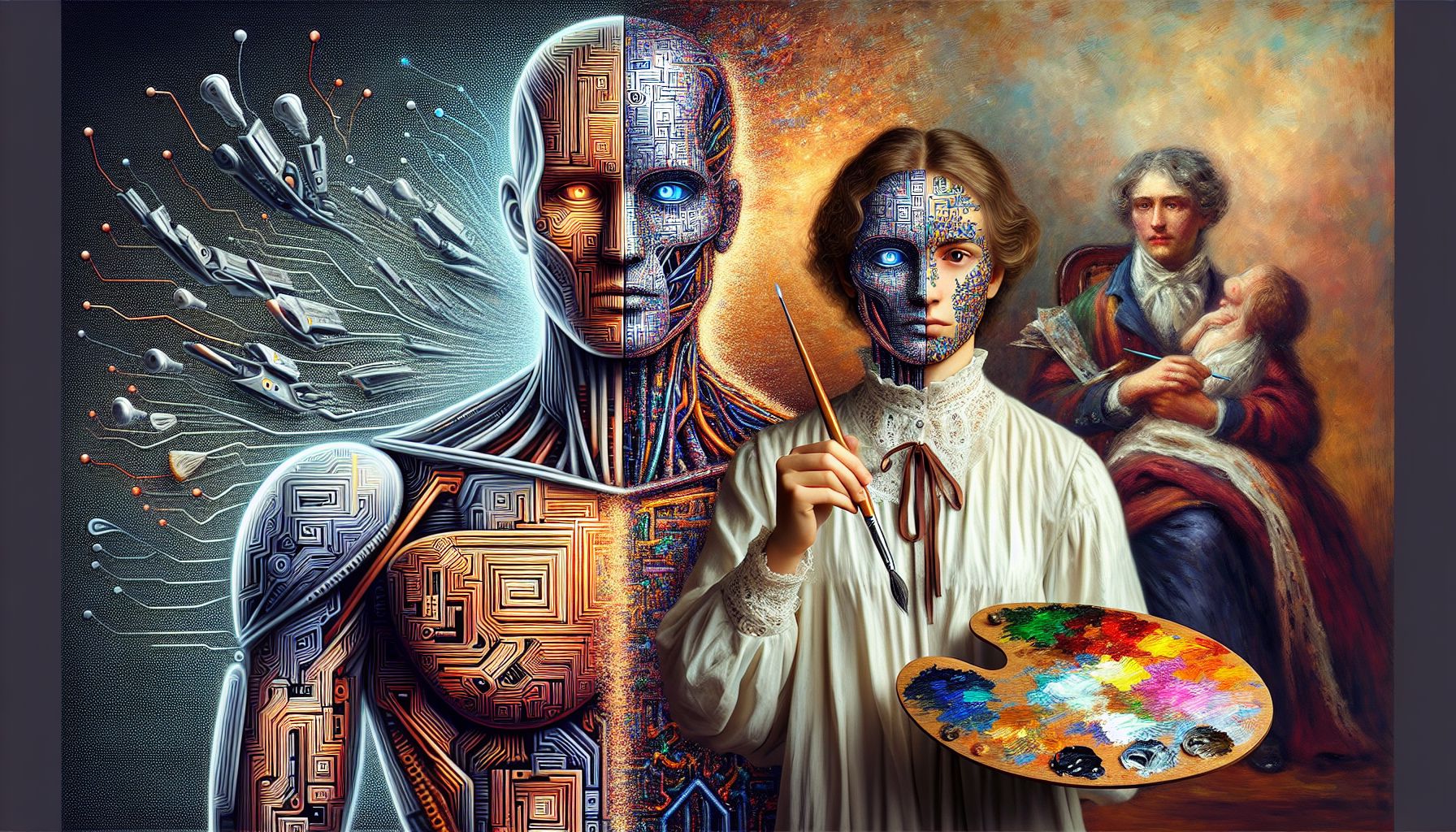
Hello, fellow tech enthusiasts and digital dreamers! Today, we’re talking about something that’s been keeping me up at night—AI in the Creative Arts. Picture it: algorithms mingling with the muses, neural networks that could rival Da Vinci’s brushstrokes, and code that composes symphonies. It’s happening right now, and honestly, it’s a pretty wild ride. So grab your favorite artisanal coffee, and let’s explore how artificial intelligence is reshaping the creative world in ways that are as exciting as they are thought-provoking.
An Artistic Renaissance or Digital Overload?
Alright, let’s address the skeptical elephant in the digital room: Can machines truly create art? This question echoes back to Picasso’s notion of art as a lie that makes us realize truth. In our era, this ‘lie’ runs on millions of lines of code. Some see this as a genuine artistic renaissance. Others call it digital overload. AI in art has stirred some fascinating debates.
On one side, AI promises to democratize art by lowering barriers to entry. Programs like DeepArt and DALL-E have become the paintbrushes of the internet age, allowing anyone—from hobbyists to budding creators—to produce pieces that once required years of practice and skill. On the flip side, some purists argue that AI-generated works lack the emotional depth and human experience that define true art. Wherever you stand, it’s hard to deny that digital or not, these creations are forcing us to reconsider what we even classify as “art” in the first place.
A Behind-the-Scenes Look at AI Creativity
If you’re new to the AI art scene, here’s the basic rundown. Most of these systems rely on what’s called Generative Adversarial Networks (GANs). It sounds intimidating, but stick with me—it’s actually fascinating! A GAN has two main components: the generator, which creates images, and the discriminator, which evaluates them. It’s a little like a digital game of cat-and-mouse, where one program dreams up an image and another verifies its authenticity.
With these twin minds collaborating and competing, an AI can come up with surprisingly realistic and often unexpectedly delightful art. It’s a bit like if Bob Ross and a script kiddo had a genius baby—it spits out happy little trees, but its tools and techniques are all ones and zeroes.
Well-Known Creators and Curators of AI Art
While a lot of AI artworks might not hang on the Louvre’s walls (yet), prominent artists are incorporating AI into their creative processes. Take Mario Klingemann, a digital artist who’s practically a legend in promoting machine learning as a medium for creativity. Or Google’s Arts & Culture Lab, which famously blended Van Gogh’s style with snapshots of modern cityscapes to fascinating effect.
And then there’s the commercial side—enterprises like OpenAI and Adobe are releasing tools that democratize AI art, pushing it into the mainstream. We’re talking tech meets tradition, algorithms meet artistry, and that incredible mingling that is the lifeblood of innovation.
The Fun and (Sometimes) Frustration of AI Art
Now, let’s tackle authenticity. One of the joys—and yes, occasional frustrations—of AI-generated art is its unpredictability. You never quite know if you’re going to end up with something that looks like it was born of pure genius or abstract to the point of absurdity. Imagine giving a cat a crayon and a canvas, and you’ll get the idea.
This unpredictability even extends to collaborations between humans and machines. The process becomes almost jazz-like: spontaneous, fluid, and oftentimes surprising. Personal anecdote: my recent attempt to create a digital version of Edvard Munch’s “The Scream” ended up more akin to a psychedelic trip with neon streaks. But hey, that’s part of the fun, right?
The Future—A Fusion of Potential and Pitfalls
Looking ahead at AI arts, I’m dreaming about entire artistic galaxies yet to be explored. Picture AI as a collaborator rather than a competitor: it could help us dig deeper into new realms of realization, offering fresh perspectives and expanding human creativity beyond its biological bounds.
Yet, we need to remember the potential pitfalls, too. As AI tools become more prevalent, discussions around intellectual property, authenticity, and the potential monopoly of art by those with computing power (yes, looking at you, mega-corporations) are bound to intensify.
In closing, AI in the creative arts challenges our conventional wisdom about the limits of both creativity and technology. I, for one, can’t wait to see where this digital brushstroke will lead us next. Keep your pencils (and keyboards) ready, friends, because the next frontier of art is upon us, and it’s more diverse and dynamic than we could have ever imagined. Let’s jump in and keep coloring outside the binary lines!
